Showing posts with label Easter. Show all posts

April 19, 2010

Patzcuaro: Tzintzuntzan Good Friday

To state the obvious, most Mexicans are Catholic. Interestingly, the number attending church regularly is the lowest of all Catholic countries, less than 50%. Some of the most striking public events in Mexico are rooted in spiritual pageantry. We got up early on Good Friday to head for Tzintzuntzan, a town not far from Patzcuaro that is famous for their elaborate Easter celebrations. The successive events begin early with the Passion Play, and continue with an enactment of the via crucis/stations of the cross, crucifixion, procession of mourning, church services and more processions late into the night. For the faithful, the occasion is a spiritual pilgrimage blending sorrow and joy. It is also an event that stems from medieval times, is steeped with history, and colored by the character of Mexico’s Indigenous peoples.

Tzintzuntzan, a Purépecha town celebrated for its history and crafts, was once the capital of the great Tarascan civilization that repelled the powerful Aztecs. Sadly, their strength was broken by European diseases even before the Spanish Franciscan monks began to build churches here in the 16th century.
Five beautifully reconstructed round Tarascan temples overlook the town.
Hooray,we found a great parking place close in by the cemetery!

No wonder, we were quite early! We strolled the huge grassy courtyard and visited the churches while waiting for the Passion Play to begin. Many huge, gnarly olive trees provide welcome shade. These were brought from Spain and planted by the Franciscans in the 16th century, and are said to be the oldest in the Americas. The pix below is just one tree!

At the end of churchyard is the Ex-Convento de San Francisco, a lovely building now restored for visitors, and the attached Templo de San Francisco, built for use by the monks and priests. In early days, the Purépechas worshiped only in the Templo de Nuestra Señora de la Salud nearby. A few of the faithful were making a long, slow passage on their knees across the churchyard to one or the other of the two churches. Family members shuffled blankets to soften their path.

Inside Templo San Francisco, the mood was sober. The large space seemed hollow, with all the images shrouded in purple and only a handful of visitors. The walls and ceiling are painted, an infinitely varied feature of the churches that intrigues me.
By contrast, the Templo de Nuestra Senora de la Salud was alive with brilliant flowers, worshipers, wandering families, and men preparing wooden images of crucified Christ for display. Everyone seemed to be welcome, and no one minded the two wandering dogs! My photos were few and furtive, as we did not want to intrude, though locals were free with their cell photos.


The walls and wooden ceiling are intricately painted in the construction style used in the earliest Spanish churches.


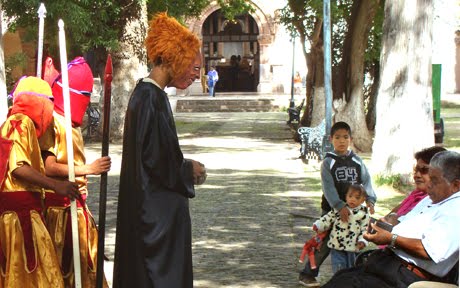

Outside again, an eerie devil/ogre strode up to us, pointed a clawed hand to his small leather purse, and demanded coins! We quickly complied, and he was off to find another mark. When he demanded a contribution from one man, the guy looked stern, held his left hand up with elbow bent out and made a flicking motion under the bent elbow with his right hand. Later, the devil confronted another who did offer coins, but apparently not enough, because now the devil himself did the elbow thing, and the man gave him more! If anyone out there knows the meaning of this versatile gesture, please tell us!

Meanwhile, across the courtyard, Jesus had appeared beneath an olive tree with head bowed and hands bound, guarded by warriors. There he would stand in silence, occasionally suffering a blow of the guard's rope whip, until the audience arrived and the play began. He accepted this important role months ago, and began to prepare himself for a difficult responsibility requiring much personal preparation.


Next, penitentes with grilletes/shackles began to enter the courtyard. They wore only a cloth wrap and hood. With one hand, each man clutched a rope that was tied to and supported their iron shackles. In the other hand they carried an alms plate. Aided by two men, the penitentes shuffled their way slowly through the crowd begging coins. Men apply to assume these roles as a personal sacrifice or atonement, surely a life-changing experience. It is a brave and sorrowful act that I admire. They were my favorite aspect of the day.

This person seemed to be a sort of silent observer... fate? Justice? Anyone know?  Dismounted, he sat on a chair, anonymous and rather encumbered by his costume, at the edge of the stage during the entire performance.


The stage was ready, set up along the wall joining the ex-convent and Templo San Francisco. Jesus was escorted back into the convent to await his entry, and the play began with rumors flying about Jesus' doings in the town.


The production was well-rehearsed, emotionally acted, and projected over a good sound system. Also, it was long! The woman above was clearly a professional. As the story evolved, Judas appeared, told his tale, and gathered up the silver coins thrown his way. Soldiers then escorted him to Gethsemane, where he betrayed Jesus with a kiss.                                    


Jesus was brought before Pontius Pilate, where bold speeches and much debate ensued about what to do next. He was beaten with whips and very real switches. This actor would have a long, difficult day.

The audience and the young guards watched, enthralled and perhaps rightly concerned.
Finally, all the actors moved off the stage, ready to move through the courtyard for the Via Cruces and Crucifixion to come. The Priest appeared, with blue-robed Christ figure and attendants. Much of the crowd began to regroup behind the actors, ready to follow.
                            
The church's collection of large crucifixes was set up on a platforms with four carrying handles, ready for a procession through the town, probably late in the day.
Chuck and I decided to depart, and joined a flow of those also leaving the churchyard. We had a picnic beside the cemetery, and came back to explore the extra large crafts market set up for the occasion.
                                   

Tzintzuntzan is particularly known for its pottery and plaited straw and natural fiber crafts. No, we didn't buy anything this day but preserved figs - we took home only memories! And pictures.
After a day that exercises all our senses, it's always a pleasure to come home to our tranquil campsite at Villa Patzcuaro, the pleasant small hotel where we've stayed during two long visits to Patzcuaro. The owners continue a long family tradition of hospitality. The property, residence, office and rooms were once part of a large hacienda at the edge of town.
The end of another very fine day!
.

April 5, 2010

Uruapan: Easter Week Tianguis Artesanal

Capital Mundial del Aguacate – that’s Uruapan, Avocado World Capital. Just 52 kilometers west and 500 meters lower than Patzcuaro, Uruapan is surrounded by rolling volcanic hills clothed with Hass avocado orchards. Our favorite, the Hass is perfect for two, at 5 pesos, about 40 cents in the Bodega/WalMart just up the street.
 
The Spanish arrived here in 1533, and gave the near-tropic town a Purépecha Indian name meaning 'Eternal Spring.' Uruapan is a mix of old low adobe and plaster buildings, and near the plaza a few unfortunately ugly early 60’s glass fronted taller structures. In spite of that, I’m quite fond of this small, somewhat tropical city of 240,000. Central Uruapan is totally walkable, from the tiny national park Barranca del Capatitzio, downhill to the strangely narrow plaza. It’s a comfortable mix of residences, a few galleries, neighborhood stores, and the shopping-oriented plaza.

But, to get to the point, Uruapan is not all about avocados! Centrally located in Michoacan state, the city promotes the tremendous variety of fine handcrafts produced in the region. We arrived early to see the parade that launched the 50th annual Tiungis de Artesanal/Artesan Market, a weeklong Easter event involving hundreds of Indigenous Michoacan craft artists. Shopping opportunities, educational programs and performances fill the week.

Leaving the quota/toll road, we promptly found ourselves lost...no surprise! Chuck boldly squeaked through crowded, narrow streets until we crossed a road on the map. Two turns and we parked. There we were,  right next to the parade route! Men and women in traditional garb were heading up the hill. Si, said the young traffic cop, the parade will begin ahora/right now. And before too long, it did.

First came the event organizers, in casual and traditional dress, row after row clattering down the street in a wild line dance, laughing and bursting with excitement!


Artisans followed, each town introducing themselves with a banner. Men, women and kids proudly carried backstrap or loom weavings, pottery, serapes, wood carvings, laquer products, metal work and more in their iconic village styles.


A surprise…the women carried small gifts in bags, to give to us spectators! Chuck was presented with miniature ceramics and a mysterious, nearly clear drink in a little cup! We downed it to no effect. I was given a tiny shoulder bag and a blue mini-apron - hey, I can use that! And, strangely, a small varnished plaque with a poem, "How Old are You?" It is very like something going around the Internet, so I'm trying not to take this personally!


 There was confetti and entertainment, there were dancers! 
These "hats" are baked circles of bread with flowers stuck into them!
                                      
There was a float of potters, and another with a flaming copper forge! 
 And plenty of security, too!
We followed the last marchers to the plaza.
The huge artisan market filled the square, a churchyard, and the cultural center courtyard. Wherever I see craft artists selling their wares, I hope and worry that these creative people will make a good return for their effort. The art was wonderful and plentiful, but the competition stiff! Many items and fabric designs were new to us. It was a treat to simply see the artisans who flooded the town in beautiful clothing, and to admire their huge talents.


The women on the left are plaiting palm leaf decorations for Palm Sunday. Above: Loom and backstrap weaving delights!
A food court featured Purépecha treats, including tortillas of blue masa/corn flour.
Before leaving, we walked a few blocks to Fábrica San Pedro, on the bank of Rio Capatitzio. This high quality craft center is located in a late 19th-century factory where marvelous woven goods are made by hand on 100-year old looms, and other artists are also represented. The program was founded in 1956 by an American couple seeking to enlarge the market for native arts. The beautifully arranged displays spotlighted work of incredible quality. Buyers pushed out loaded carts and carried huge bundles of goods, likely bound for stores in the U.S. and Canada.

This is the street where we parked our truck. A party is going on in the green house...we saw pastries delivered, and several well dressed guests arrive! Behind the faded wall may be a flowered courtyard surrounded by lovely rooms.

Driving out of town this woman with daughter and infant crossed the highway. She had been selling her wares, too…perhaps food she’d fixed at home.  In Mexico, so many people go to a great deal of effort to sell little bits of things, trying to make ends meet. I hope she had some success.