Showing posts with label Mexico Festivals. Show all posts

April 19, 2010

Patzcuaro: Tzintzuntzan Good Friday

To state the obvious, most Mexicans are Catholic. Interestingly, the number attending church regularly is the lowest of all Catholic countries, less than 50%. Some of the most striking public events in Mexico are rooted in spiritual pageantry. We got up early on Good Friday to head for Tzintzuntzan, a town not far from Patzcuaro that is famous for their elaborate Easter celebrations. The successive events begin early with the Passion Play, and continue with an enactment of the via crucis/stations of the cross, crucifixion, procession of mourning, church services and more processions late into the night. For the faithful, the occasion is a spiritual pilgrimage blending sorrow and joy. It is also an event that stems from medieval times, is steeped with history, and colored by the character of Mexico’s Indigenous peoples.

Tzintzuntzan, a Purépecha town celebrated for its history and crafts, was once the capital of the great Tarascan civilization that repelled the powerful Aztecs. Sadly, their strength was broken by European diseases even before the Spanish Franciscan monks began to build churches here in the 16th century.
Five beautifully reconstructed round Tarascan temples overlook the town.
Hooray,we found a great parking place close in by the cemetery!

No wonder, we were quite early! We strolled the huge grassy courtyard and visited the churches while waiting for the Passion Play to begin. Many huge, gnarly olive trees provide welcome shade. These were brought from Spain and planted by the Franciscans in the 16th century, and are said to be the oldest in the Americas. The pix below is just one tree!

At the end of churchyard is the Ex-Convento de San Francisco, a lovely building now restored for visitors, and the attached Templo de San Francisco, built for use by the monks and priests. In early days, the Purépechas worshiped only in the Templo de Nuestra Señora de la Salud nearby. A few of the faithful were making a long, slow passage on their knees across the churchyard to one or the other of the two churches. Family members shuffled blankets to soften their path.

Inside Templo San Francisco, the mood was sober. The large space seemed hollow, with all the images shrouded in purple and only a handful of visitors. The walls and ceiling are painted, an infinitely varied feature of the churches that intrigues me.
By contrast, the Templo de Nuestra Senora de la Salud was alive with brilliant flowers, worshipers, wandering families, and men preparing wooden images of crucified Christ for display. Everyone seemed to be welcome, and no one minded the two wandering dogs! My photos were few and furtive, as we did not want to intrude, though locals were free with their cell photos.


The walls and wooden ceiling are intricately painted in the construction style used in the earliest Spanish churches.


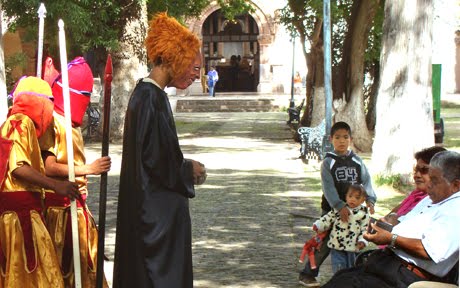

Outside again, an eerie devil/ogre strode up to us, pointed a clawed hand to his small leather purse, and demanded coins! We quickly complied, and he was off to find another mark. When he demanded a contribution from one man, the guy looked stern, held his left hand up with elbow bent out and made a flicking motion under the bent elbow with his right hand. Later, the devil confronted another who did offer coins, but apparently not enough, because now the devil himself did the elbow thing, and the man gave him more! If anyone out there knows the meaning of this versatile gesture, please tell us!

Meanwhile, across the courtyard, Jesus had appeared beneath an olive tree with head bowed and hands bound, guarded by warriors. There he would stand in silence, occasionally suffering a blow of the guard's rope whip, until the audience arrived and the play began. He accepted this important role months ago, and began to prepare himself for a difficult responsibility requiring much personal preparation.


Next, penitentes with grilletes/shackles began to enter the courtyard. They wore only a cloth wrap and hood. With one hand, each man clutched a rope that was tied to and supported their iron shackles. In the other hand they carried an alms plate. Aided by two men, the penitentes shuffled their way slowly through the crowd begging coins. Men apply to assume these roles as a personal sacrifice or atonement, surely a life-changing experience. It is a brave and sorrowful act that I admire. They were my favorite aspect of the day.

This person seemed to be a sort of silent observer... fate? Justice? Anyone know?  Dismounted, he sat on a chair, anonymous and rather encumbered by his costume, at the edge of the stage during the entire performance.


The stage was ready, set up along the wall joining the ex-convent and Templo San Francisco. Jesus was escorted back into the convent to await his entry, and the play began with rumors flying about Jesus' doings in the town.


The production was well-rehearsed, emotionally acted, and projected over a good sound system. Also, it was long! The woman above was clearly a professional. As the story evolved, Judas appeared, told his tale, and gathered up the silver coins thrown his way. Soldiers then escorted him to Gethsemane, where he betrayed Jesus with a kiss.                                    


Jesus was brought before Pontius Pilate, where bold speeches and much debate ensued about what to do next. He was beaten with whips and very real switches. This actor would have a long, difficult day.

The audience and the young guards watched, enthralled and perhaps rightly concerned.
Finally, all the actors moved off the stage, ready to move through the courtyard for the Via Cruces and Crucifixion to come. The Priest appeared, with blue-robed Christ figure and attendants. Much of the crowd began to regroup behind the actors, ready to follow.
                            
The church's collection of large crucifixes was set up on a platforms with four carrying handles, ready for a procession through the town, probably late in the day.
Chuck and I decided to depart, and joined a flow of those also leaving the churchyard. We had a picnic beside the cemetery, and came back to explore the extra large crafts market set up for the occasion.
                                   

Tzintzuntzan is particularly known for its pottery and plaited straw and natural fiber crafts. No, we didn't buy anything this day but preserved figs - we took home only memories! And pictures.
After a day that exercises all our senses, it's always a pleasure to come home to our tranquil campsite at Villa Patzcuaro, the pleasant small hotel where we've stayed during two long visits to Patzcuaro. The owners continue a long family tradition of hospitality. The property, residence, office and rooms were once part of a large hacienda at the edge of town.
The end of another very fine day!
.

March 8, 2010

Oaxaca - Monos and More


We’ve been in the Oaxaca Campground for a week, doing tourist duty as much as our bodies will allow! It's a big change after our leisurly months in Roca Azul, Jocotepec.

Oaxaca is in southern Mexico, in a region rich many indigenous cultures. The city sits at the center of three valleys, surrounded by extensive mountains with networks of dirt roads, some rarely traveled by outsiders. Our drive down the new cuota was breathtaking!

The campground is very convenient, within long-walk distance to town. There's also a bus two blocks away, though the return route remains a mystery. We walk halfway home to get a bus! It may be that torn-up streets are the problem. Like other Colonial cities we’ve seen lately, Oaxaca is getting spruced up for the 2010 Bicentennial in September. Many streets and some museums are closed for renovations. Thinking of a Mexico trip? Come NEXT year, everything will be perfect!

On Monday, we walked. Along the busy highway, we stopped short in front of an auto repair shop, eye-to-eye with a gigantic paper mache head…and torso, very female! A guy was gluing strips to the face. Behind him was a huge pink-faced, clothed male. Jose de Monos is an artist who creates monos - the giant puppets used in special weddings, processions and festivals. Monos are set on bamboo frames and carried from underneath, bobbing and twirling along the street. They’re a Oaxaca specialty, we'd never seen them in real life!  Jose is a master, he created the pair on display in the Santo Domingo Cultural Center, where we were headed! Eager to show us more, Jose went into the dark shop, reached above boxes and tires, and pulled down a long-lashed doll in gold. Then he set Chuck up to pose!

We ate lunch at an espresso-café. My huevos divorciados were really good, the beans like soup but tasty. This brings to mind a related topic, a gripe among us gringas. We've been out and about four days now...four full days with lunches. EVERY bathroom has had toilet seats, soap and paper towels!! This says something about Oaxaca, as far as I'm concerned! I've hardly seen a seat in three months! I think I'll start investigating more common locations, such as supermarkets. Stay tuned.

The Lonely Planet calls the Iglesia Santo Domingo the most splendid of Oaxaca's churches. The church was built along with a huge monastery between 1570 and 1608. Unlike some orders, the Dominicans were very protective of the indigenous peoples.    And, they sure knew how to impress!


The Santo Domingo Cultural Center, housed in the monastery – is extensive, with a gorgeous building and collections that connect pre-Hispanic cultures to contemporary indigenous communities. There's a separate botanical garden within the monastery walls, that we glimpsed from the upper balconies.
 
The city center is beautiful, with a modern outlook, historic architecture, and rich array of handcrafts and arts.
Oaxaca has a very diverse population. We'll try to give you more glimpses in coming days.
The next time we went to town, while wandering el centro we glimpsed monos bobbing along two blocks ahead! I said to Chuck, "Meet you in the plaza!" and trotted up an adjacent block, arriving in time to see a gorgeous traditional wedding party gathering for a group photo on the walking street, monos gone, off in the distance! Some Saturday, I may just hang around the plaza, hoping for another grand wedding!

February 22, 2010

Carnival in Cholula, Pueblo

Yesterday, February 21, was so much fun that we'll have to delay telling you about Queretaro, Teotihuacan & Mexico City! Now, our first day in Cholula.

In 1519 when Cortez arrived here, Tepanapa, the second largest pyramid in the world, had already been abandoned to strife among indigenous tribes. Cortez and his 500 men killed 6,000 people, gained control of 100,000 indigenous inhabitants, and built a church atop Tepanapa, now known as the Great Pyramid of Cholula.

It was an easy drive from San Juan Teotihuacan on 40D, and we got to Las Americas Trailer Park in San Pedro Cholula  in time for lunch. It’s a number of blocks out of town, but we could hear loud booms and explosions from all around the el centro area. What in the world? While we were eating, Mike & Terri Church came walking back from town and told us that Carnival was going on! It is a week late here, lucky for us. They also warned about the extremely high noise level, caused by gunshots! Oh. As soon as lunch was over I set off to investigate, earplugs in pocket, while Chuck did projects at home.

Things had quieted down around 3:00, but random shots were still being fired, so I followed the sound. Like Mardi Gras in New Orleans, after a parade, marchers go to their own gang’s home base to eat and drink. Many men carry elaborately carved muzzle-loading weapons. Some of the guys kept playing with their guns in between refreshments, so I watched.  After painstakingly pouring powder and tamping, they move into the road, execute a sudden, three-step turn, and send a shot to the ground or the air. KaBOOM! I quickly put on  earplugs!   
                                                     
Then I found my way along mostly empty streets to a cluster of churches lining a huge plaza and even larger central garden. People flowed from the churches into the already crowded plaza.


Families and paraders who had dropped their masks were eating lunch on the grass and watching clowns, musicians and entertainers. Vendors sold souvenirs and food. Candy and gunpowder aromas mingled. I worked up the nerve to ask, and maskers were delighted to pose for pictures!

As I left the square, there was a parade coming toward me – they’d started up again! I chased gunshots and parades down street after street for some time.
Heading home I got lost, mixing up my Nortes and Orientes! I asked a counter guy in a tienda/store for directions to a panteon/cemetery I’d passed; then a family on the street in front of their house for directions to a green-walled panteon (I’d found a white one). Three women working at a pharmacy had too many ideas, and at last a policeman set me straight. Though our conversation was in Spanish, he enjoyed writing out directions in a complete sentence – in English! Tiredness had elevated my concern level somewhat, but I knew I’d find my way eventually. I sure got a walking workout, and next time I’ll take notes!
This pix was not my idea, but theirs!
I've never seen costumes like today's. Does anyone know their origin?

January 22, 2010

El Senor del Monte Procession

Last Sunday, a bright, mild late afternoon, Chuck, our RV neighbor Sonia and I went into Jocotepec to see the highlight event of the annual El Senor del Monte festival. The honored El Senor is removed from his position above the Cathedral altar and carried around the town in a grand procession. Participants include locals, residents of small towns near and far, and many “absent sons,” those who have left for work up north, but return to visit their families at this time.

We arrived in time to see one of two green arches erected on Matamoros Street.
At 4:00, El Senor would be carried out of the Cathedral by select church leaders and high clergy into the eager crowd waiting in the courtyard. Where we waited on Matamoros Street, venders walked the parade route selling candles, food, and toys as spectators gathered. Aromas of  flat, sweet grilled gorditas, crisp bunuelos (can’t spell that one) and roasting corn kindled our appetites.
                                                       We gave in.

As the light became rosy with the lowering sun, penitents and their helpers began to lay down folded blankets. Many would greet El Senor on their knees with extreme humility, in supplication, atonement, entreaty or thanks, progressing along the parade route towards the approaching icon.

Then, we heard drums and stamping feet and the clacking metal shoes of the blue-suited Indians, and saw the multitude of the procession appear. The Indian dancers, stamping their feet in a repeated rhythm, were surrounded and followed by a crowd of townsfolk carrying on the dance. This contagious emotion is my  favorite part of the event!                            


The street became thick with people, many with candles, some walking blindfolded, arm-in-arm with a companion. More Indians, a band, and then El Senor! Honored men maintained space with a rope barrier. The priests walked within, and El Senor del Monte was carried aloft. They were followed by a truck with loudspeakers. Prayers were read, an old woman with a rather shaky voice led a song, and the crowd joined in quietly and sweetly. To my ear, it is a haunting, somber chorus. Thousands walked by us.

When the huge crowd began to dwindle, we wandered the central streets, which were lined with plastic tarps and wooden tables set up by itinerant vendors who sold just about everything you can imagine. One booth might be thirty feet long, stacked high with kitchen goods, another a modest table with a few shoes.

This was a moving and fascinating experience. We went home for a late, light meal, but most folks in town would have a long night. The plaza and adjacent streets were crowded with people enjoying loud music, carnival rides and arcade games. Restaurants and bars set up in the street were selling snacks, beer, tacos, carnitas, and the local favorite – birra, or goat stew.