Showing posts with label RV Canada. Show all posts

August 26, 2010

A Most Welcoming Door

The long, fertile Annapolis Valley is dotted with tiny towns, apple orchards and farms - an idyllic, almost totally rural setting. Nestled  among beautiful trees, roughly halfway between Digby and Windsor, just an hour and a half from Halifax, is Paula & Jerry’s lovely home. These folks know how to enjoy and appreciate life! They’re fellow Mexico RV travelers, too.Kingston Chickadee in Hand


Chickadees are almost members of the family, and they’ll come to house guests, too.  Hint: peanuts,  patience, persistence!


And, can they pack a lot of fun into just one day! We begin in Halifax: The Halifax Maritime Museum, with an iron cage as a Pirate’s Fate. Two ship tours. The Busker’s Festival.

Halifax A Pirate's Fate  


Lunch at the Old Triangle Pub, Halifax potato dishes: the boxie, a potato pancake folded over seafood filling with potatos on the side. Haibut and mashed, the mashed on top, quality comfort food!


Kingston Evangeline at Grand Pre Then we were off to Grand Pré, a site memorializing 1766 expulsion of nearly 10,000 Acadians from the Maritimes by the British. It’s called the grand derangement here, it sounds like a sort of insanity. The site and the time are embodied in the Evangeline statue, taken from Longfellow’s poem, “Evangeline, A Tale of Acadie.” The Acadians had built a fruitful farming life around ingenious dike systems supporting rich fields, which are used to this day.

Many of those Acadians went to Louisiana, and contributed hugely to the unique cultural mix we enjoyed so much during our years there. I guess that’s why we came to Nova Scotia…where we’ve discovered so much more!


Our winding route took us through the town where Paula & Jerry were married, and on to an overlook view towards the Avon River.

Nearing sundown, we arrived at Halls Harbor (oops, Harbour) for dinner. It’s a sliver of water between steep hills – at high tide, that is. The huge Bay of Fundy tides were at the max. A valley stream is the source of the only water in this marina today!

Kingston Hall's Harbour 2


A toast to friends, the day, and to this beautiful, welcoming province!

August 16, 2010

Quebec and Quebec City

We hereby introduce “Quickie“ posts to give you glimpses of our travels! They will keep you on your toes because they’re usually out of order, just notes about past days. But does that matter, anyway? They’ll tell you about more great places we’ve been. Chuck keeps up the link in the right-hand column that gives you our current location at all times.

Quebec, the province: French was one too many languages for me (must focus on Spanish!), but some handy words from high school classes did pop up from the ordinarily inaccessible depths. Fortunately, visitors needn’t speak French! Bilingual translations are usually available, and friendly folks will help. All those in the tourist trade are wonderfully hospitable – and speak English with charming accents.

North of Montreal, in the Laurenians, we had a fine visit with campers and Mexico experts Jimmy and Julie- such a fine artist and his equally talented muse!


Quebec, the city: We took a ferry across the St. Lawrence River from  our Levís campsite for a  day’s immersion in a city with a long and rich history. It was  grey, windy and cold! But beautiful.

Let’s see some street artists! First, crowds gather to watch performers in the lower town, where buildings are crowded between the cliffs and the waterfront.


We wandered throughout fascinating streets in the upper town, which is within the high stone fortification walls that line the cliff edge. Cannons overlook the river.

The horses pulling the many carriages are well-loved performers! Here’s their necessary drinking fountain. 


Many more skilled artists are found in the pretty squares and along the narrow streets. The “flowerpot” near this fire-eater is shaped entirely of topiary. You think these guys are looking at the unicyclist rather nervously? They have good reason. A cartoon artist develops a sketch of a young ballplayer.


Heading to the RV back in Levís, we discovered a shop with 40 flavors of soft ice cream! Mine is crème de menthe. A cool toast to a great day.

August 3, 2010

Pasty, Poutine, Cipialle – Time for Dinner!

Food history. Food stories. I’d hazard a guess that many foods have an interesting, but little-known history. We’ve tried a few local favorites recently. Here they are in the order sampled.
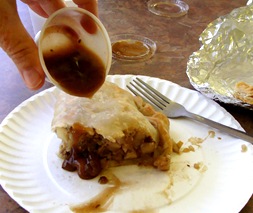
Pasties. The pasty (rhymes with nasty) is a firm meat pie you can pick up and eat by hand, a staple in Michigan’s U.P. (Upper Peninsula. See the previous Michigan post.) The filling is beef, pork or vegetarian, with potatoes and bits of carrot, turnip optional but more authentic. Everyone has a favorite place to buy their pasties for a quick lunch or dinner. We tried our first when we saw so many signs along Highway 2. Dobbers, a local chain, also fills mail orders – by Fedex if a distant UP’er is so homesick they’re willing to pay big bucks for a quick dozen. Order online!
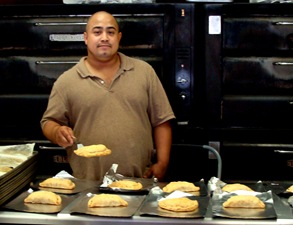
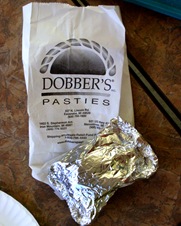


                                                              Good with wine!Pasties on Table

The U.P. hills are rich with copper and iron. European immigrants came to this wild country to work the mines, and founded the many little towns that simply sprang up around mine shafts. The Cornish came first, in the early 1800’s, bringing their mining skills and traditions from  the old country, including a miner’s staple lunch, the pasty. This lightly seasoned meat pie was portable, and could be eaten cold or heated on a shovel over a miner’s headlamp. No tools required, it’s eaten by hand or with a fork, gravy or catsup optional.

It’s dark as a dungeon…and dirty and dangerous.
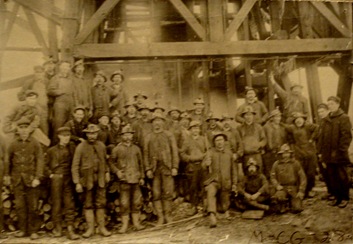
When the mining slowed in mid-century, the Cornish went home. Finns, Swedes and others remained, and continued to make pasties. The mines boomed again late in the 1800s, the timeframe my grandparents settled in the U.P. He was a miner, and I imagine my grandmother fixed pasties for him and made little ones for the children, including my mom.

02 Grandma Autio

01 Grandfather

01 Grandmother Audio                                                                     


It’s Finn country – and we missed a Finnish festival by one week!

Finnish flag in the Iron Mountain museum.
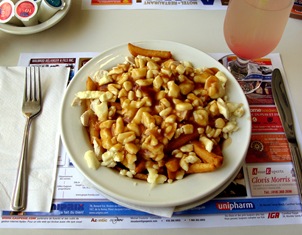


Poutine. Frankly, when this Canadian dish was described and recommended to us, I thought it sounded awful!

What you see here is french fries topped with fresh cheese curd and covered with brown gravy, with an optional item, diced chicken. There are many favorite additions to the basic recipe. Hamburger’s favored. Another variation is to use pizza sauce. It seems that the sky’s the limit! 


Poutine appeared in the late 1950s, and quickly became popular. We first saw it at a fast food chain located inside a Canada Visitor Welcome Center! It’s a staple nationwide, even served in school cafeterias. I was told we’d like it.

It’s sold at most fast food joints, in greasy spoons and in family restaurants, where we found it in Gaspé and I finally dared to try it …and I DO like it! The gravy does make the fries stay warm longer. This one’s easy to make, so here’s the basic recipe:

The French fries should be of medium thickness and fried so that the inside stays soft, while the outside is crunchy. Use a light gravy - chicken, veal or turkey, mildly spiced with a hint of pepper. Sprinkle cheese curd over all. I don’t know where you get this, but it must not be more than a day old. To substitute, use little chucks of an extremely mild cheese. To maintain the texture of the fries, the cheese curd, then gravy must be added immediately prior to serving.

Variations are apparently endless. Poutine made Mexican-style is called “carne asada fries.” Consult Wikipedia for  high and low class variations, and a couple of political jokes. Or this fine site:  http://www.montrealpoutine.com/

Cipaille, or Sea Pie (which is how it is pronounced). We walked the wharf at Rivièr-au-Renard, a small fishing town  near the tip of the Gaspé Peninsula. Couldn’t find any restaurants near the harbor, so we went to a supermarket for readymade salads. We also picked up two cipailles in small square bread tins to have for dinner.


When we reached the fishing docks, we found the town restaurant! And watched fishermen offload their turbot catch. It’s a slow process, using a shovel to empty fish from the icy hold into the bucket, which is lifted ashore, weighed and emptied into a shipping box! Three boats can be simultaneously unloaded at separate weighing sheds along the pier.


Back home in the RV, we stuck the cipaille in the oven for dinner. It’s a slightly juicy meat pie with delightfully crispy pastry and funny name. The ingredients label: porc, boeuf, pataters, oignon, poiure, epices, mélangees, pate, farine, griasse, poude a pate, sel.

Freetranslation.com can’t provide a translation for cipaille, but an online source notes a similar dish in Hannah Glass’s 1747 The Art of Cookery made Plain and Easy, a valuable info source for culinary practice in England and the American colonies. The recipe is for ‘Cheshire Pork Pie for Sea’ with layers of salt pork, meat and potatoes.

Though every Canadian province claims the dish, it probably originated in the Gaspesie region. It also  resembles the English dish “six pies” made with four kinds of game, such as duck, moose, elk, hare and partridge. Cipaille is definitely old, and is still popular in households where there’s a hunter.

The Cipaille was the best! I call it yummy.

July 29, 2010

A Leap Across Canada

Today I set out to post a blog. And it’s about time! Since leaving New Orleans in June we’ve been so tightly scheduled with visits, activities and studying about places ahead that you’ve not heard much from us. As a new blog addict, this situation weighs on my mind. I can write only in my sleep. I try not to let guilt overcome me. Many places call out for recognition, yet have not been revealed! ARGH, as my pirate friends would say! A taste of our route:

Michigan Iron County! My first wild blueberries.


The Shipwreck Museum with 1849 Light Station! Since commercial shipping began on the Great Lakes, there have been 6,000 shipwrecks. The Edmund Fitzgerald is among the tragedies spotlighted here. Lost during a monster storm on November 10, 1975 with 29 men aboard, she was immortalized in song by Gordon Lightfoot.

     …That good ship and true was a bone to be chewed
        When the gales of November came early…

Edmund Fitzgerald Bell

Shipwreck Lighthouse & Rudder


                                 Soo Locks, with tour boat and freighter passing through! Soo Tour Boat

Mattawa LumbermanOntario, Canada! Ontario HwyThat’s a BIG lumberman in lovely Mattawa.


We’ve had good times and don't regret it, but I aim for time ahead to share more! We did rush along, and all because we wanted to get where we are NOW before summer's gone.

And where would that be? you might ask.

We’re in the Gaspésie, the part of Quebec Province that swells into the Gaspe Peninsula and lies north of New Brunswick Province. It’s a region steeped in traditions of the Amerindians, Vikings, French, Basques, Acadians, British Loyalists, Bretons, Scottish and no doubt others. Last year, the National Geographic Society designated the Gaspésie as the third most beautiful destination in the world! We’re especially drawn by the cultures, music, and history of the seacoast – the spectacular scenery is a plus.

Our campground is in Cap-Chat, a small town on the south shore of the St. Lawrence River, which is so wide here that you can't see the other side. It’s a seaway first navigated by Amerindians, with many tales to tell. As we drove farther and farther from Quebec (OMGosh I haven’t told you about Quebec!) the landscape was occasionally reminiscent of the Northern California or Oregon coast. That is, if you could include rich green farms on rolling slopes lined with pines and edged by purple, yellow and white wildflowers!

We’ve three days here to relax beside the river with Cap-Chat a bit misty across the way, windmills towering strangely on a ridge. Yesterday we were pinned down by strong, chilly winds that whipped up river waves, shook the camper all night and day, and encouraged general laziness and putting off of all tasks.

That’s OK, it was nice and sunny!