Showing posts with label American History. Show all posts

December 9, 2011

Christmas 2011

Happy Holidays and Warmest Season’s Wishes from the Taylor home, still on wheels. Greetings and hugs to our family and friends! And welcome to our other visitors, too!

We’ve added another year to our personal chronicle, and wonder…How could it have flown so quickly, yet given us so many new experiences and memories? We’re now having a bit of cool weather and welcome rain here in Austin. It’s perfect for a good hot soup and sharing a few 2011 tales.

Wupatki Pueblo (11)Chuck & Gigi at Cleator

2011 Main Stomping Ground: Arizona – far enough north to touch the Utah border on the way to Monument Valley; and New Mexico – four passes through, including a hop north to Rico, CO. In Texas, we were east to Bastrop and south to Port Mansfield. That’s a sport fishermen’s town on the Gulf, where our previous boat home for 21 years is now at the dock. She’s no longer called La Mouette, but she may travel again!

Number of 2011 Campsites: Thirty-one. This includes brief stops and longer, but we rarely rush off before we’re ready. We’ve been tethered to Austin for medical biz and follow-ups, three visits. 

Here are a few 2011 superlatives.

Good Friends: We shared our time this year with many we visited on our travels. It’s always wonderful to connect with family, with sailing, radio and camping friends, and even one of Gigi’s college roomies. Happily, they’re to be found all over the country, especially in the southwest. We track them down. Too many to embarrass them all with their pictures here!

Favorite Campsite: El Morro RV, Ramah, NM. In August the woods, ground cover and flowers were fragrant, campsite casual, hiking handy and sights nearby include Morro Rock, Zuni Pueblo, Spirit Wolf Sanctuary, Art Gallery, more. This busy crowd was always there – at our two feeders! 

El Morro Hummingbird (46)

Zuni Pueblo: At the Old Zuni Mission, men are buried to the left and women to the right. Traditionally, men are responsible for the spirit and ceremonial; women for the home. These craftsmen sell light switch covers.

Zuni Church (5)Zuni Church (2)

Spirit Wolf Sanctuary: Sadly, many  people want Wild Spirit Wolf Sanctuary (3)to own a wolf-dog mix, so people do breed them. Most end up in shelters or in sanctuaries. Here there are full-blooded wolves, too, like this white one (typical big feet).  Some come from small zoos that go under or can’t handle them.

Produce market at Ramah: Held weekly outside the community historic museum. Yum.Ramah Historical Museum (1)

Toadlena, NM (31)Favorite Place Revisited: We were heading south to Gallup through the Navajo reservation and meant to pass by until we saw the sign. Our wheels turned down the road to Historic Toadlena Trading Post, where owners sell daily goods as they celebrate and support the weaver’s art through exhibitions and more. We arrived in time to join a collectors’ tour of the current exhibition, and to view the owner’s residence and special pieces.

Toadlena, NM

Best Parade: In Gallup, NM, the annual Inter-Tribal Indian Ceremonial parade included Native American tribes from the US and Mexico. We’ve seen it before, and enjoyed it again. Later in the day, the Rodeo and dances were pretty much rained out!

Gallup Intertribal Ceremonial Parade (19)Gallup Intertribal Ceremonial Parade (27)

Tijeras SnowMost welcome departure: At the Tijeras, NM campground east of Albuquerque, we had snow…but had to stay two more days because, well, we were paid up!

Easiest Park to photograph: Monument Valley, where you cannot take a bad photograph! Eons ago, this land was beneath the Sea of Cortez, Mexico.

Monument Valley (31)Monument Valley (65)

Awesome-est Place: Canyon de Chelly National Monument. It was also the toughest park to photograph. It’s just too grand to express through the limiting lens. But I tried. And tried. Left pix: There are ruins in the low dark alcove. Right: Spider Rock below, 800 feet high.

Chelly S Rim (50)White House (58)Chelly S Rim (98) Spider Rock Area

If you go, take a tour of the Canyon! The road in is also the river bed. 

Chelly S Rim (50)White House (37)

 Tour (48) Pictograph Tour Pictograph Stop 2-4

We chose Antelope Tours, and saw several ruins and many pictographs. Ben, our guide, took us to his family home, located next to Antelope ruins. Maybe because we liked his stories so much, he did a u-turn to give us an extra view of Standing Rock, located in a family pasture lined with old apple trees that the bears love. Here, a small Navajo group fought to successfully escape the Long Walk, the most terrible part of the tribe’s history and a shameful tactic by US troops that led to the death of thousands.

Tour (79) Standing Rock

Thinking of Christmas:

Nice potential gift for her (silver hair ornament):

Gallup Intertribal Ceremonial Parade (64)

Nice gift for him (pick one only) Belen, NM:

Harla May Fat Boy Grill Oysterz

Happy New Year!!!

February 1, 2011

Texas Two-Step

We’re officially Texas residents because our mailbox is in Livingston, the Escapees campers’ home base - but we’re really just sightseers as we pass through headed east or west, north or south. We get to visit nephew Marc in Bastrop more often than any other family members. A pleasure! We stopped here for Christmas – and also so that Chuck could see a urologist in Austin. His Louisiana doc was booked into January, and we wanted to move on west.


Passing the time before the appointment, playing Mexican Train with Maggie, Kelvin & Marc!
083 


A biopsy was recommended and taken. Waiting for results, we moved south to Hondo to check out the Escapees Lone Star Corral Co-op (Texans love Texas themes). In winter the area is rather barren, but the history of small towns once accessible only by buggy and the railroad seems starkly real.


TX Hondo St Dom Primitive Stone Heart
TX Hondo St Dom Church & Tree


The closest town to the campground is D’Hanis, founded by twenty-nine families from Alsace, France in the mid 1800s. The San Dominic Church was abandoned in 1914 when the town center relocated closer to the train route. Many graves are early immigrants and children who died during an 1810 diphtheria outbreak.
San Antonio has the largest group of Spanish Colonial missions in the US, and a unique history! The area was home to semi-nomadic Indian populations when it was contested by  Spanish and French explorers. The Spanish built the missions, and taught the Indians to farm and raise cattle. Some Spanish horses escaped or were stolen, and spread north across the plains into Canada. In 1722, San Antonio  was the capitol of Spanish Texas. After Mexico won independence, they governed the land north of the Rio Grande. In battles following the 1836 fall of the Alamo, the independent Republic of Texas was born, which briefly became a US state before seceding in 1861 with other Southern States despite the heated objections of Governor Sam Houston. At the end of the Civil War, Texas rejoined the union.
Here in San Fernando Cathedral lie the remains of Travis, Crockett, Bowie and other defenders of the Alamo. In 1936 they were disinterred and placed on public view for a year before being placed here. You’ve got to wonder, would they do that sort of thing today? Bones?
We’ve visited all five Spanish missions along the San Antonio River. At Mission San Juan, dating prior to 1750, a docent told about his great-grandparents of Mexican heritage, who were married in the San Juan Mission Church, where he attends services each Sunday. Electricity is installed, walls crumbling.


Today San Antonio is a vibrant multicultural city, as we learned at the beautiful San Antonio Museum of Art during a visit with Curator of Contemporary Art David Rubin, who I worked with at the Contemporary Arts Center in New Orleans. 
TX SAMart David Rubin
TX SAMart Gary Sweeny Assemblage


We came back to Marc’s in mid-January. Chuck had his follow-up visit and the biopsy was positive – which or course is NOT good, he has cancer. Fortunately it is small, contained and not aggressive. He’ll have a series of radiation treatments in Austin.
But it’s so COLD here just now! Look closely, that’s ICE on our frozen-solid water hose! Further, we’d planned this trip to see what Arizona and New Mexico were like in winter (whining)! Well, the doc confirmed that treatment is not a rush but should be attended to soon…so we’re heading west and will return at the end of March, when the Texas bluebonnets are in full bloom!  
074 (2)


More Texas icons:


Yes! Extreme hog hunts! Come & get ‘em.

November 13, 2010

The Shot Heard Round the World!

October 2010: I saw the sign flash by and called out over our loud Dodge engine, “Take the next exit!”
We were headed down 95 from Bar Harbor, ME toward Mystic, CT, just enjoying the fall colors, when we approached Lexington and Concord, and the sign marking the Minute Man National Historical Park popped up.

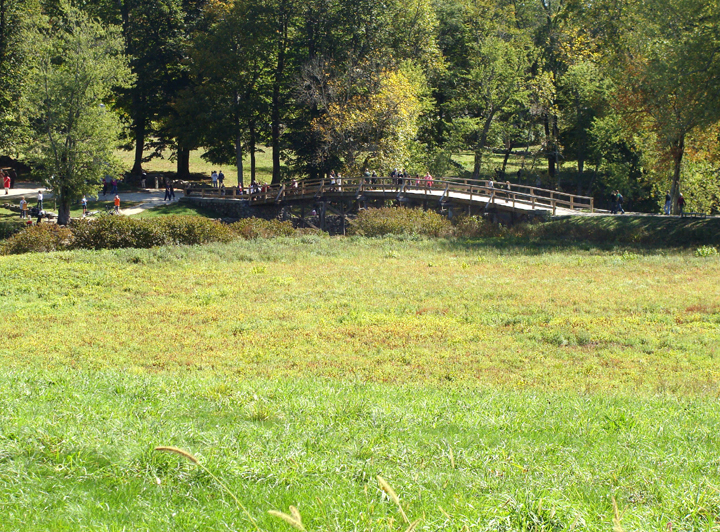
What was a country dirt lane at the start of the American Revolution is now 2A, the winding Lexington Road, lined with suburban neighborhoods and clusters of older buildings. The Park follows the crooked road, where battles once were fought. We got lost, then found ourselves at the  historic North Bridge scene by pure luck. There's Chuck on the bridge.


Costumed reenactors representing both the British and Colonists told us their views of what happened on April 19, 1775. They answered questions while cleverly sticking to their roles.


The months leading to this day were a tense time for both British and colonists. In Boston, British troops enforced rigid new rules, arresting colonial leaders and confiscating their weapons. Colonists throughout the countryside were infuriated by the restrictions imposed. Not trusting the British, they created bands of Minute Men and cached guns to protect local communities.

Paul Revere set out in the dark last night, April 18, 1775  on his famous ride through Mystic, Arlington and Lexington, waking colonists, alerting them that British troops were marching to Concord to search for stashed weapons. Revere was captured outside Lexington by a British Patrol at 1:30 am on April 19, but his associate, William Dawes, escaped to continue warning residents along the road that the British were on their way. Minute Men gathered in homes, farms and town squares along the route.

At dawn, 77 armed colonists stood in the field near the Concord River North Bridge. On an overlooking rise were 700 British soldiers. Captain John Parker, leading the outnumbered colonials, intended to simply make a display of patriot resolve. A shot rang out – the shot heard round the world! To this day, no one knows which side fired, but British Major John Pitcairn could not stop his troops from shooting at the now fleeing colonials. Eight were killed.

And here we were, where the action took place. It was an eerie feeling to know that the scene had changed little in 234 years.

This is the British viewpoint of the field where the colonists stood on that April 19th morning.


Today, artists on the other side of the bridge look up at the hill where the British appeared. It's easy to imagine their presence!


Ralph Waldo Emerson wrote the words “the shot heard round the world” in his poem, Concord Hymn. The poem was sung as a hymn on July 4, 1837 when the tall Concord Monument was installed next to the bridge. The spire commemorates the American Minutemen resistance to British forces.


The famous phrase appears on this Minute Man sculpture at the site, where he stands with with his gun and plow.

The British went on to Concord to search for colonials’ weapons while word of the killings spread like wildfire throughout the area. Colonists along the route the British would take back to Boston were ready for a fight. Wild skirmishes took place along road as the British headed home. At Lexington, the British gained 1,000 British reinforcements who had rushed out from Boston. At one point, over 5,000 men  were fighting on both sides before the British reached safety in Boston, where gunships protected them.


The score: British – 73 dead, 174 wounded. Colonists - 49 dead, 40 wounded. The ultimate result: a rebellion that set the stage for an eight year war for independence and creation of the United States of America. In March 1776, British troops would leave Boston.


There are several fine battle paintings and a film at the the Minute Man Historical Park, which includes historic buildings along the battle road. The Park Visitor Center also has a great film.

Maybe because I grew up in the far west – Hawaii – I find the eastern U.S. historic sites fascinating! The Revolution, historic towns and buildings and the Civil War.  Funny, I've not read many of the fine books about those days, but being there is always intriguing. The history becomes real when you can be a witness on the spot. I feel the same way standing atop a pre-historic temple in Mexico, but somehow that’s a different sort of adventure!

This day also proves that many of our most fun times happen on the spur of the moment. No planning needed!


CONCORD HYMN by Ralph Waldo Emerson


By the rude bridge that arched the flood, 
Their flag to April's breeze unfurled,
Here once the embattled farmers stood,
And fired the shot heard round the world.
The foe long since in silence slept;
Alike the conqueror silent sleeps;
And Time the ruined bridge has swept
Down the dark stream which seaward creeps.

On this green bank, by this soft stream,
We set today a votive stone;
That memory may their deed redeem,
When, like our sires, our sons are gone.

Spirit, that made those heroes dare
To die, and leave their children free,
Bid Time and Nature gently spare
The shaft we raise to them and thee.