October 2010: I saw the sign flash by and called out over our loud Dodge engine, “Take the next exit!”
We were headed down 95 from Bar Harbor, ME toward Mystic, CT, just enjoying the fall colors, when we approached Lexington and Concord, and the sign marking the Minute Man National Historical Park popped up.
What was a country dirt lane at the start of the American Revolution is now 2A, the winding Lexington Road, lined with suburban neighborhoods and clusters of older buildings. The Park follows the crooked road, where battles once were fought. We got lost, then found ourselves at the historic North Bridge scene by pure luck. There's Chuck on the bridge.
Costumed reenactors representing both the British and Colonists told us their views of what happened on April 19, 1775. They answered questions while cleverly sticking to their roles.

The months leading to this day were a tense time for both British and colonists. In Boston, British troops enforced rigid new rules, arresting colonial leaders and confiscating their weapons. Colonists throughout the countryside were infuriated by the restrictions imposed. Not trusting the British, they created bands of Minute Men and cached guns to protect local communities.
Paul Revere set out in the dark last night, April 18, 1775 on his famous ride through Mystic, Arlington and Lexington, waking colonists, alerting them that British troops were marching to Concord to search for stashed weapons. Revere was captured outside Lexington by a British Patrol at 1:30 am on April 19, but his associate, William Dawes, escaped to continue warning residents along the road that the British were on their way. Minute Men gathered in homes, farms and town squares along the route.
At dawn, 77 armed colonists stood in the field near the Concord River North Bridge. On an overlooking rise were 700 British soldiers. Captain John Parker, leading the outnumbered colonials, intended to simply make a display of patriot resolve. A shot rang out – the shot heard round the world! To this day, no one knows which side fired, but British Major John Pitcairn could not stop his troops from shooting at the now fleeing colonials. Eight were killed.
And here we were, where the action took place. It was an eerie feeling to know that the scene had changed little in 234 years.
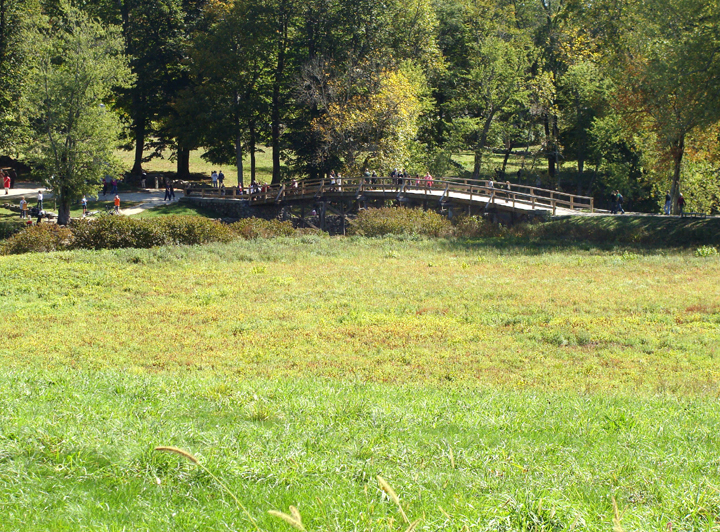
This is the British viewpoint of the field where the colonists stood on that April 19th morning.
Today, artists on the other side of the bridge look up at the hill where the British appeared. It's easy to imagine their presence!
Ralph Waldo Emerson wrote the words “the shot heard round the world” in his poem,
Concord Hymn. The poem was sung as a hymn on July 4, 1837 when the tall Concord Monument was installed next to the bridge. The spire commemorates the American Minutemen resistance to British forces.
The famous phrase appears on this Minute Man sculpture at the site, where he stands with with his gun and plow.
The British went on to Concord to search for colonials’ weapons while word of the killings spread like wildfire throughout the area. Colonists along the route the British would take back to Boston were ready for a fight. Wild skirmishes took place along road as the British headed home. At Lexington, the British gained 1,000 British reinforcements who had rushed out from Boston. At one point, over 5,000 men were fighting on both sides before the British reached safety in Boston, where gunships protected them.
The score: British – 73 dead, 174 wounded. Colonists - 49 dead, 40 wounded. The ultimate result: a rebellion that set the stage for an eight year war for independence and creation of the United States of America. In March 1776, British troops would leave Boston.
There are several fine battle paintings and a film at the the Minute Man Historical Park, which includes historic buildings along the battle road. The Park Visitor Center also has a great film.
Maybe because I grew up in the far west – Hawaii – I find the eastern U.S. historic sites fascinating! The Revolution, historic towns and buildings and the Civil War. Funny, I've not read many of the fine books about those days, but being there is always intriguing. The history becomes real when you can be a witness on the spot. I feel the same way standing atop a pre-historic temple in Mexico, but somehow that’s a different sort of adventure!
This day also proves that many of our most fun times happen on the spur of the moment. No planning needed!
CONCORD HYMN by Ralph Waldo Emerson
By the rude bridge that arched the flood,
Their flag to April's breeze unfurled,
Here once the embattled farmers stood,
And fired the shot heard round the world.
The foe long since in silence slept;
Alike the conqueror silent sleeps;
And Time the ruined bridge has swept
Down the dark stream which seaward creeps.
On this green bank, by this soft stream,
We set today a votive stone;
That memory may their deed redeem,
When, like our sires, our sons are gone.
Spirit, that made those heroes dare
To die, and leave their children free,
Bid Time and Nature gently spare
The shaft we raise to them and thee.